 | |
| Schoolgirls discovered heroine of Holocaust | |
UNTIL September, 1999, the name of Irena Sendler was unknown outside Poland.
In fact, it is unlikely if few outside Warsaw had ever heard of her. But a high school class of 14-year-olds in Uniontown High School, Kansas, America, undertaking a project for National History Day, changed all that and set in motion an incredible train of events. They discovered that not only had Irena saved the lives of 2,500 Jews from the Warsaw Ghetto, but the school project led directly to the establishment of a centre for unsung heroes. It all began when Megan Felt, a pupil in inspirational history teacher Norm Conard’s form, led a project among her classmates that researched the story of Irena Sendler (Sendlerowa), a Polish Catholic social worker. There had been only one brief mention of her on the internet. They wrote a brief play about her called Life in a Jar, which has since been performed more than 375 times throughout America and Europe. The following year, the pupils discovered that Irena was still alive and began corresponding with her. In May, 2001, Norm and his pupils flew to Poland to meet her. And their efforts to spread her story led to her nomination in 2007 for the Nobel Peace Prize. For some years, Norm had encouraged his classes to research unsung heroes. Today, he is no longer a teacher after 30 years in the classroom. He became inaugural executive director of the Lowell Milken Center for Unsung Heroes, in Fort Scott, Kansas, when it opened in 2007 and Megan, now married with two children of her own, is programme director. The Center’s aim is “to transform classrooms and communities through student-driven projects that discover unsung heroes from history and teach the power of one to create positive change”. Megan recalled: “Ours was a white, Protestant school of 100 pupils doing diversity projects. I had never met anyone Jewish. “Several other girls and myself decided we wanted to learn more about the Holocaust. “We found a 1994 news report, Other Schindlers, featuring five rescue stories and saw the name of Irena Sendler. “I thought it was an error when I read she had saved 2,500 lives. “Norm suggested that we do a Google search, but we could find only one piece about her.” The girls continued to research but could find no further information in English. They started preparing material for a 10-minute play and after searching for burial records discovered that Irena was still alive in Warsaw. They wrote to her, enclosing money for a return stamp. They received a seven-page reply two months later, entirely in Polish. Megan said: “She told us her story and of her nightmares. She asked herself whether she could have done more.” Money was raised for Megan, her mother, three friends and their grandparents and Norm to fly to Poland. They found dozens of reporters waiting to greet them. “It broke the story to the world,” said Megan. What the class of 1999 discovered was that Irena had continually entered the Warsaw Ghetto and persuaded parents and grandparents to hand over their children to her, pointing out that otherwise all would die in the ghetto or in Nazi concentration camps. Irena, together with 25 allies, smuggled the youngsters out and arranged for Polish families to adopt them or hid them in convents or orphanages. The Polish underground in London became aware of her activities and raised funds to assist her. Irena hid lists of the children's names in jars which she buried in a colleague’s garden beneath an apple tree so their identities would not be lost whatever happened to her. Irena posed as a nurse and, wearing a Magen David armband, she used to enter the disease-ridden Warsaw Ghetto. A Polish doctor forged papers stating she was a nurse. The Nazis, who feared typhoid spreading in the ghetto, were happy to let Polish medical workers handle the sick and the dead. She hoped after the war to reunite children with their parents. Sadly, the parents all died. But the jars did preserve the youngsters’ real names. Elzbieta Ficowska, nee Koppel, was five months old when one of Irena’s associates gave her a narcotic to make her sleep and placed her in a wooden box with air holes. The box left the ghetto with bricks on a horse-drawn wagon in July 1942. Ficowska’s mother hid a silver spoon in the baby’s clothes. It was engraved with her nickname, Elzunia, and her birth date: January 5, 1942. Elzbieta was taken in by Sendler’s associate Stanislawa Bussoldowa, a widowed Catholic midwife. For a few months, Elzunia’s mother was able to telephone and hear her daughter gurgle. Soon, both parents died in the ghetto. The escape routes were many and ingenious. Sometimes, as with Ficowska, Irena and her team hid the children in boxes or sacks and took them out of the ghetto in a truck. Sometimes, the children travelled in an empty, or almost empty, tram linking the ghetto with the outside world, and driven by a cooperative driver. At other times, Irena and her helpers passed children through the secret basements of buildings, including a court, on the edge of the walled-in ghetto to the city outside. Irena was arrested in a Gestapo night raid on her apartment on October 20, 1943. The Nazis took her to the dreaded Pawiak prison. Few left there alive. She was tortured and bore the scars, but refused to betray her team. The Polish resistance bribed a Gestapo officer. He put her name on a list of executed prisoners and released her. She went into hiding under an assumed name but continued her activity. Megan recalled the day she finally met Irena: “She was in a wheelchair, but stood up and walked towards me. She gave me a strong grandma embrace. It was so powerful and emotional. “She talked about the Jewish mothers and grandmothers being the real heroes [because they had to hand over their children to her]. “The most emotional moment of my life was sitting at Irena’s feet and looking over her shoulder I could see my mother sitting there — the strongest women in my life; my two guardian angels.” She added: “I looked into her eyes, the eyes that looked into so many parents’ eyes.” Megan has played various parts in the stage production, more recently appearing as Irena herself, surely befitting the young lady who ensured the Polish heroine would never be forgotten and who became a surrogate mother to Megan whose own mum sadly succumbed to cancer. Irena died in 2008. Her grave in Powazki cemetery, the largest Catholic burial ground in Warsaw, has been desecrated numerous times. The Milken Centre’s lobby is dominated by a life-size apple tree with jars, one an original, that contained the names of children Irena saved, placed beneath it. As I took my leave of Megan and the remarkable Centre, she turned to me and declared: “Now you can see why I pinch myself every day.” Next year is Irena Sendler Year in Poland. Thanks to the intrepid pupils of Uniontown High School and their teacher, a true heroine whose deeds may have gone uncelebrated and undocumented will enter the annals of Holocaust history. The Milken Centre has now involved hundreds of thousands of schoolchildren in 31 countries and is currently working on about 100 new unsung heroes’ projects, only about 10 per cent of which involve Jews. And Fort Scott has become the town of the unsung hero, attracting visitors from around the world to the centre, including Israelis. There were 10,000 last year alone and 50,000 since Milken opened. A tourism official told me: “The input is that many people come to Fort Scott as a result. “But they come and realise that there is more to the town than just the Milken Centre.” The eponymous Gordon Parks Centre, for instance, honours the photographer, filmmaker, writer and musician who was born in Fort Scott in 1912 and wrote about his home town in his celebrated autobiographical novel and subsequent film, The Learning Tree. He became a world-renowned photojournalist for Life Magazine, chronicling the civil rights movement for two decades. His work for Vogue magazine established him as a master of fashion photography. He was the first African-American to direct a major Hollywood production — The Learning Tree — filmed on location in Fort Scott.
|
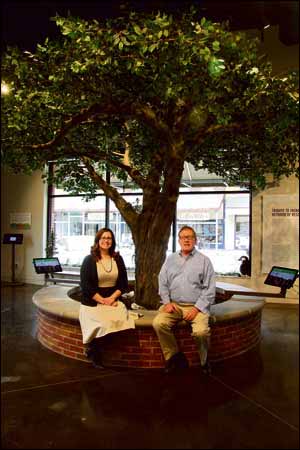 PUPIL AND TEACHER: Megan Felt and Norm Conard beneath the replica tree